How Malaysian Sellers Can Prevent Overselling During E-Commerce Live Sales
Erra22 Sep 2026 08:46ENCopy link & title

How Do Basic Inventory Tools Fail Malaysian Sellers During Mega Sale Events?
When it comes to live selling, basic inventory tools go from being a minor headache to a complete business liability. Traditional e-commerce involves a relatively predictable, passive checkout flow. Live streams on TikTok Shop Live or Shopee Live create an entirely different reality: hundreds of orders are locked in within a single minute, and buyers are highly reactive.
Basic inventory tools fail uniquely and spectacularly in a live-selling environment for several reasons:
1. The 15-Minute "API Sync Lag" Destroys Stock Accuracy
Most basic multi-channel tools or simple plugins update your stock levels via batch processing, usually checking in every 15 to 30 minutes.
During a mega sale, a host might say, "I only have 50 pieces of this wireless earbud at 70% off, click the orange bag now!" Those 50 pieces will sell out in 20 seconds. While TikTok Shop registers the item as sold out, your basic system is still waiting for its next 15-minute sync cycle. During those 15 minutes, the system tells your connected Shopee or Lazada store that you still have stock. Non-live buyers on other apps purchase stock that physically no longer exists, triggering a cascade of painful order cancellations and severe platform penalties.
2. The Danger of "Bag Pinning" and Real-Time Over-allocation
In live commerce, hosts actively pin products to the screen to drive immediate checkouts. This causes massive, isolated spikes on a single product variant.
If you split your inventory manually beforehand (e.g., allocating 100 units to TikTok and 100 to Shopee) to keep things "safe," you artificially cap your sales. If the TikTok crowd is wild but Shopee is dead, you miss out on revenue. Basic tools cannot dynamically move stock allocation from a dead channel to a live channel on the fly. Conversely, if you link a shared pool of 100 units to both channels without instantaneous deduction, both platforms will simultaneously sell the same 100 units.
3. Zero Support for Live Affiliate Co-Streaming
Many growing Malaysian brands don't just stream from their own account; they hire multiple external MCNs (Multi-Channel Networks) or freelance TikTok creators to co-stream and sell the exact same warehouse stock simultaneously during a mega sale night.
The problem is five different creators are live at 11:00 PM, all pitching your viral beauty product, but basic inventory apps have no concept of "shared warehouse buckets with multi-streamer access tokens." They treat every store connection as a singular, slow-moving pipeline. One viral creator can completely drain your physical warehouse stock in two minutes, leaving the other four creators actively selling thin air to thousands of viewers.
What Should Malaysian Sellers Look For in a Stock Locking ERP?
Not every "inventory tool" actually prevents overselling. When evaluating an ERP for live sales, Malaysian sellers should look for:
-
Cross-platform, cross-store inventory sharing that updates in real time the moment an order is confirmed, not on a scheduled refresh.
-
Campaign-reserved stock, the ability to ring-fence a specific quantity for a live session or flash sale so it can't be double-sold against regular listing stock.
-
Push rules and push records that show exactly when and where each stock update was sent, so discrepancies can be traced and fixed quickly.
-
Multi-warehouse and multi-unit support, since many live sellers fulfil from more than one warehouse or 3PL and need stock consolidated accurately across all of them.
-
Official API authorisation with the platforms being sold on (Shopee, Lazada, TikTok Shop), rather than third-party scraping, which is slower and less reliable during high-traffic events.
-
Mobile access, so stock counts can be checked and corrected in real time from the phone during the live broadcast itself, not just from a desktop afterward.
How Does BigSeller Automate Real-Time Inventory Control for Local Sellers?
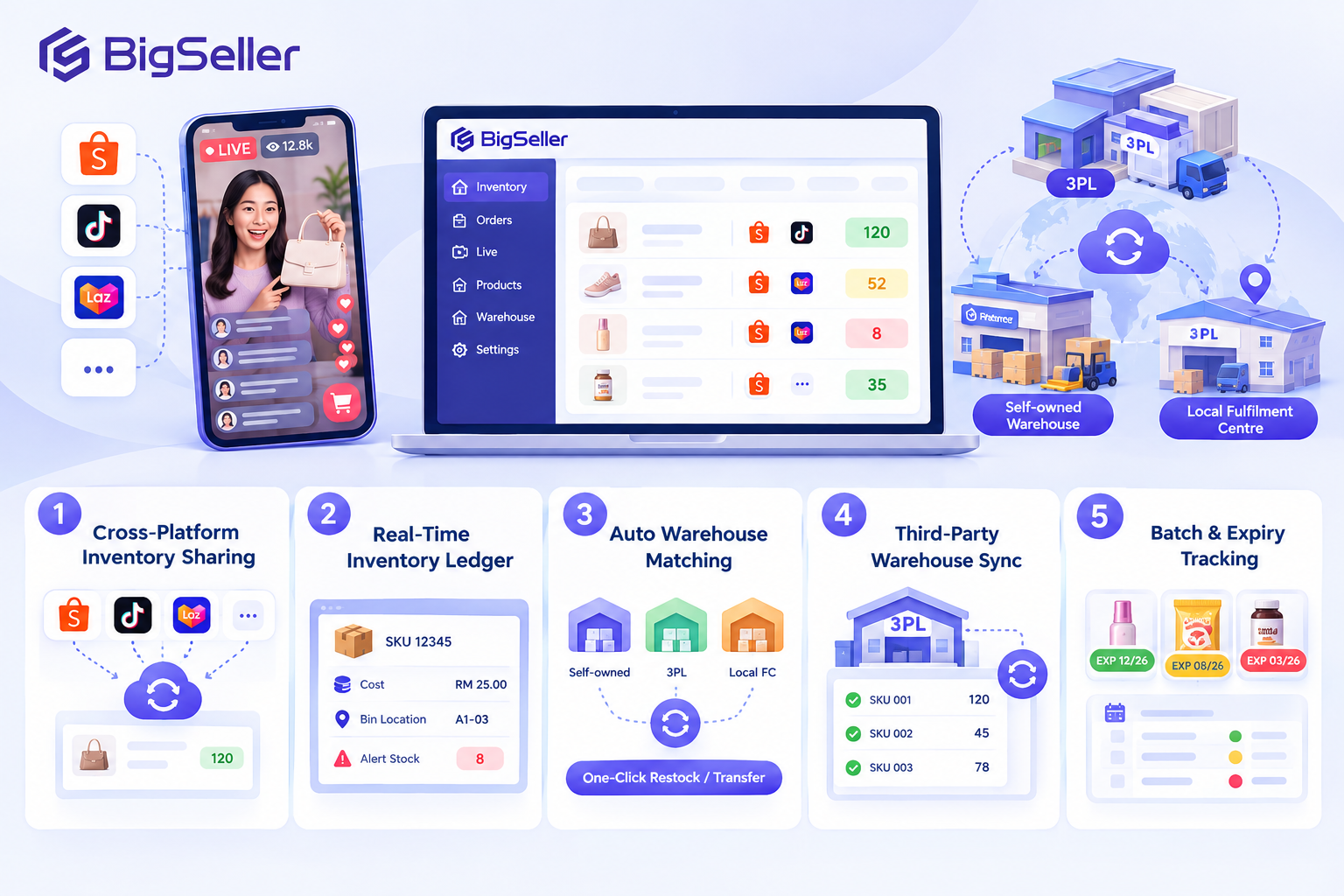
To avoid getting banned or heavily penalised by platform algorithms due to fulfillment failure, sellers in Malaysia usually use BigSeller, a free cloud-based ecommerce ERP built for Southeast Asian marketplace sellers, giving centralised management of orders, inventory, product listings, and fulfilment across Shopee, Lazada, TikTok Shop, and 16+ platforms from a single dashboard. For live sellers specifically, BigSeller’s Inventory Module addresses overselling at the source:
-
Multi-tool overselling prevention with cross-platform inventory sharing: campaign-reserved stock, push rules, and push records keep inventory accurate across every connected store and platform simultaneously.
-
Real-time inventory ledger for every SKU, covering cost, bin location, and alert stock levels, so low-stock items are flagged before they run out mid-live.
-
Automatic warehouse-inventory matching across self-owned warehouses, overseas 3PLs, and local fulfilment centres, with one-click restocking or transfer for out-of-stock items.
-
Third-party warehouse sync, pulling 3PL stock levels into the same dashboard so sellers aren't reconciling separate systems manually mid-campaign.
-
Batch and expiry tracking, useful for live sellers in F&B, beauty, and health categories who need to avoid selling near-expiry stock during high-volume flash sales.
On top of stock control, BigSeller's Promotion & Campaign Management lets sellers bulk-create and schedule Shopee and TikTok Shop flash sales and bundles across multiple stores with time-zone-aware scheduling, pairing the promotional side of a live event with the inventory-locking logic that keeps it from overselling.