ECOCHIC: The Digital Operations Journey of a Standout Fashion Brand on TikTok Shop
Jayson12 Jun 2026 10:07ENCopy link & title
ECOCHIC's story began with a very simple aspiration: to create fashion products that are beautiful, comfortable, and environmentally responsible.
At a time when "sustainable fashion" is sometimes treated as a marketing slogan, co-founder Quynh Tran chose to prove it through the wearer's real experience.
For ECOCHIC, a good product is not defined only by design or material. It must reach customers through multiple senses. Quynh Tran describes this philosophy as "what the eyes see, the ears hear, the nose smells, the hands touch, and the body feels."
"What the eyes see" is when customers encounter a design that is beautiful, easy to wear, and reasonably priced. "What the ears hear" is when the brand is mentioned on social media, or when the wearer receives compliments from people around them. "What the nose smells" is the pleasant feeling when opening the package. "What the hands touch" is fabric that is soft and reliable enough to build trust from the first touch. And "what the body feels" is the moment customers put the product on and genuinely feel comfortable.
"Every product needs not only to look good, but also to feel comfortable when customers touch it and wear it."
- Quynh Tran, Co-founder of ECOCHIC

This attention to detail has helped ECOCHIC gradually build customer trust. Rather than relying on heavy advertising, the brand grew through real experiences: customers bought, came back to buy again, and shared their experiences on social media.
Many people discovered ECOCHIC through very natural recommendations:
"ECOCHIC's clothes are comfortable to wear, and you can really feel that they take every product seriously."
By the end of 2024, ECOCHIC had become one of the standout fashion brands on TikTok Shop. The hashtag #ecochic recorded more than 200 million views, helping the brand reach more and more consumers.
But rapid growth always comes with a bigger operational question: how can the operating system keep up with the pace of growth?
As orders surged across TikTok Shop, Shopee, and Lazada, ECOCHIC began facing familiar pressures for multi-platform sellers: unsynchronized inventory, manual order processing, a warehouse with many difficult-to-control SKUs, and a higher risk of shipping the wrong item or canceling orders during peak seasons.
That was when ECOCHIC began optimizing its operating processes together with BigSeller.
| Category | Content |
|---|---|
| Client | ECOCHIC |
| Industry | Fashion |
| Sales channel | TikTok Shop, Shopee, Lazada |
| Challenge | Asynchronous multi-floor inventory, manual order processing, and a warehouse with many SKUs are difficult to manage. |
| Solution | Synchronized inventory across multiple platforms, automated order processing, WMS warehouse management. |
| Result | Order processing time decreased by approximately 50%, operational efficiency during Mega Sale increased by about 3 times, TikTok Shop grew by over 80%, and Shopee grew by over 50%. |
When Growth Becomes Operational Pressure
For a fashion brand like ECOCHIC, growth is not measured only by views or order volume. Behind every order is a chain of operational tasks that must be handled accurately: checking inventory, confirming orders, picking items, packing, printing shipping labels, handing orders over to logistics providers, and updating order status.
When order volume was still small, the team could handle these steps manually. But as the brand grew quickly across multiple platforms, manual work began to reveal its limits.
A fashion product can have many colors and many sizes. A single shirt design with three colors and three sizes already creates nine SKUs. When the number of styles grows to hundreds of SKUs and the products are sold simultaneously on TikTok Shop, Shopee, and Lazada, managing them with Excel or manual actions on each platform becomes highly prone to discrepancies.
For ECOCHIC, the question was no longer "how do we get more orders?" Instead, it became:
How can the team keep up when orders increase sharply, keep the warehouse under control, make sure customers receive the right products, and protect the shopping experience?
1. Multi-Platform Inventory Synchronization: Reducing Overselling and Order Cancellations
One of the biggest headaches for ECOCHIC's team was that inventory was not updated in time across platforms.
When selling on multiple marketplaces, the same product may be listed on TikTok Shop, Shopee, and Lazada. If inventory is not synchronized automatically, the team has to keep updating quantities manually. This is especially difficult to control when orders are generated continuously throughout the day or during major sales campaigns.
A common situation was this: a product still appeared as available on TikTok Shop, a customer placed an order, but when the warehouse checked, the actual item was already out of stock. The shop then had to cancel the order, which affected the customer experience and created the risk of a lower platform rating.
"We used to use Excel to synchronize inventory manually, but with three platforms and hundreds of SKUs, the team could barely keep up with updates."
- Doan Tran, representative of ECOCHIC's operations team
After connecting its stores to BigSeller, ECOCHIC could manage inventory centrally in one system. When an order was generated on one platform, inventory was automatically deducted and updated, reducing the team's dependence on manual data entry.
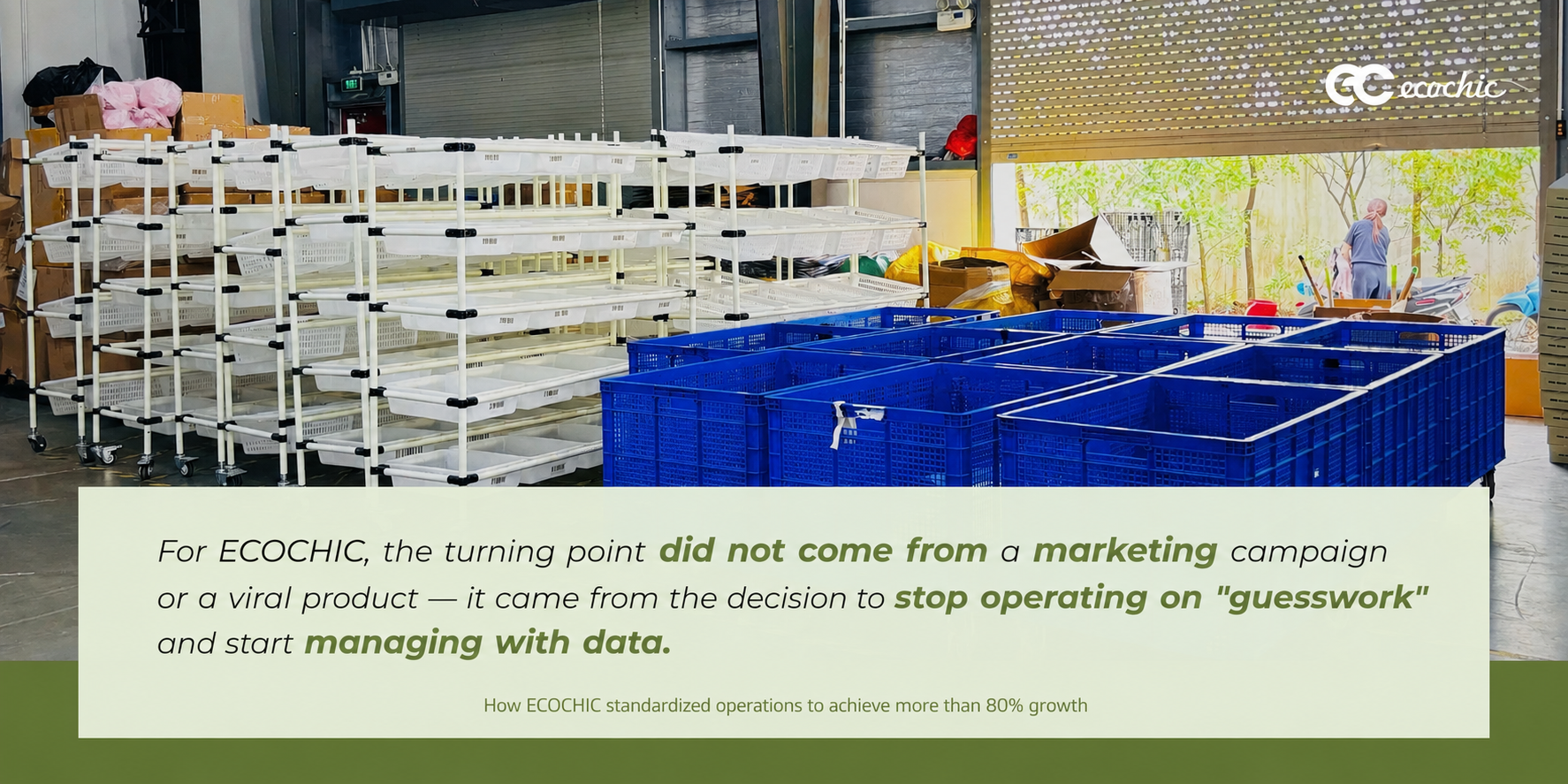
For ECOCHIC, the biggest change was not simply "having another inventory management tool." It was that the team could gain clearer control over product status across multiple sales channels.
Instead of constantly checking each platform and updating Excel files, the team could monitor inventory centrally, proactively identify which products were running low, determine which products needed replenishment, and reduce cases where customers placed orders for items that were no longer available in the warehouse.
BigSeller supported ECOCHIC in several key areas:
- Synchronizing inventory across TikTok Shop, Shopee, and Lazada.
- Automatically deducting inventory when orders are generated.
- Reducing the risk of overselling, stockouts, and order cancellations.
- Supporting safe-stock alerts so the team can proactively replenish inventory.
- Managing data from multiple warehouses centrally, making allocation and order processing more convenient.
For a fashion brand with many colors, sizes, and SKUs like ECOCHIC, inventory synchronization significantly reduces operational pressure, especially during periods of fast order growth.
2. Automated Order Processing: Keeping Efficiency Aligned with Growth
After inventory, ECOCHIC's next challenge was order processing speed.
Previously, the warehouse's order processing workflow depended heavily on manual operations: checking orders on each platform, printing documents, finding products, packing, rechecking information, and handing orders over to logistics providers.
When order volume was small, this process could still work. But during Mega Sale events such as 11.11 and 12.12, sudden spikes in order volume could easily overload the warehouse. Staff had to keep checking orders, printing documents, finding products, and packing. If just one step was delayed or incorrect, the entire downstream process was affected.
ECOCHIC's team once tried adding more staff during peak periods, but quickly realized that the issue was not only the number of people. What ECOCHIC needed was an order processing workflow that could scale as order volume increased, rather than relying only on adding headcount.
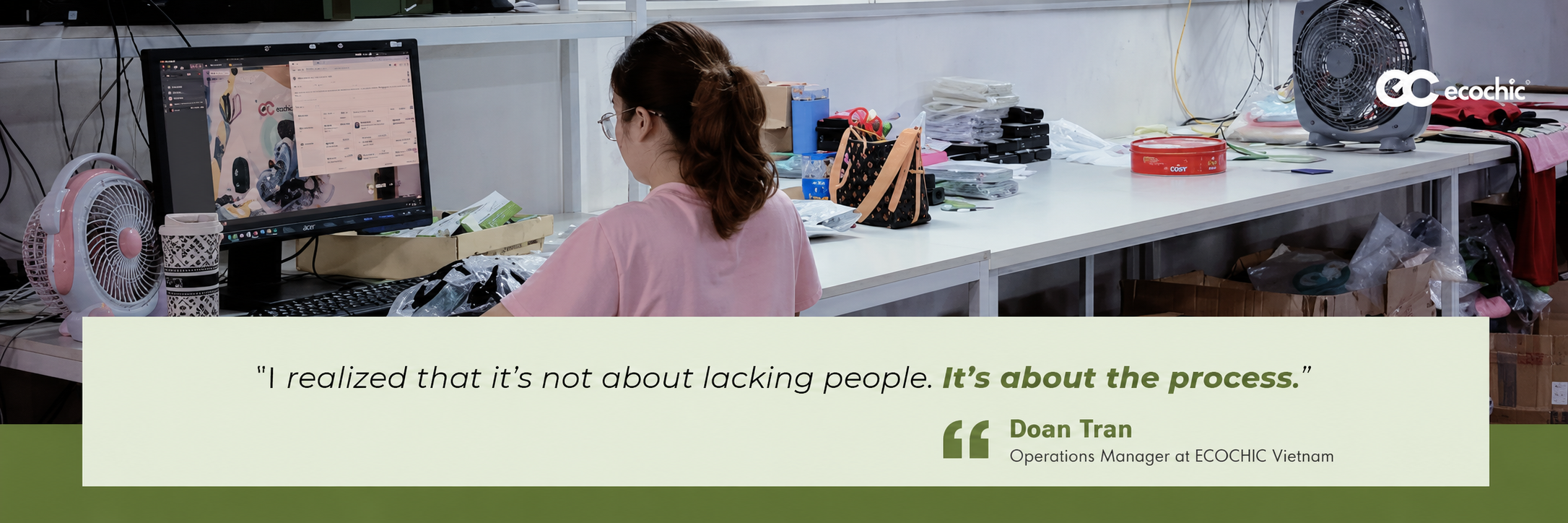
With BigSeller, orders from TikTok Shop, Shopee, and Lazada are synchronized into one centralized management system. The team no longer needs to switch constantly between multiple platforms to check and process orders. Actions such as order classification, warehouse allocation, shipping label printing, and logistics handover preparation are handled more centrally. This makes the order processing workflow clearer:
- Orders from multiple marketplaces are consolidated into one interface.
- The team can process orders in batches instead of handling scattered individual orders one by one.
- Shipping labels can be printed in bulk, saving time during peak hours.
- Orders can be allocated to the appropriate warehouse for picking and packing.
- Processing and logistics handover become more seamless.
For ECOCHIC, the benefit was not only faster order processing, but also less chaos in the warehouse. When the workflow is systematized, every team member knows what they need to do, what status each order is in, and what the next step should be.
Tasks that once kept the whole team working late during sales periods have now been shortened significantly. The team can handle a larger order volume without depending entirely on manual operations on each platform.
3. WMS Warehouse Management: Turning the Warehouse from a "Black Box" into a Transparent System
In the fashion industry, the warehouse is always one of the hardest areas to control.
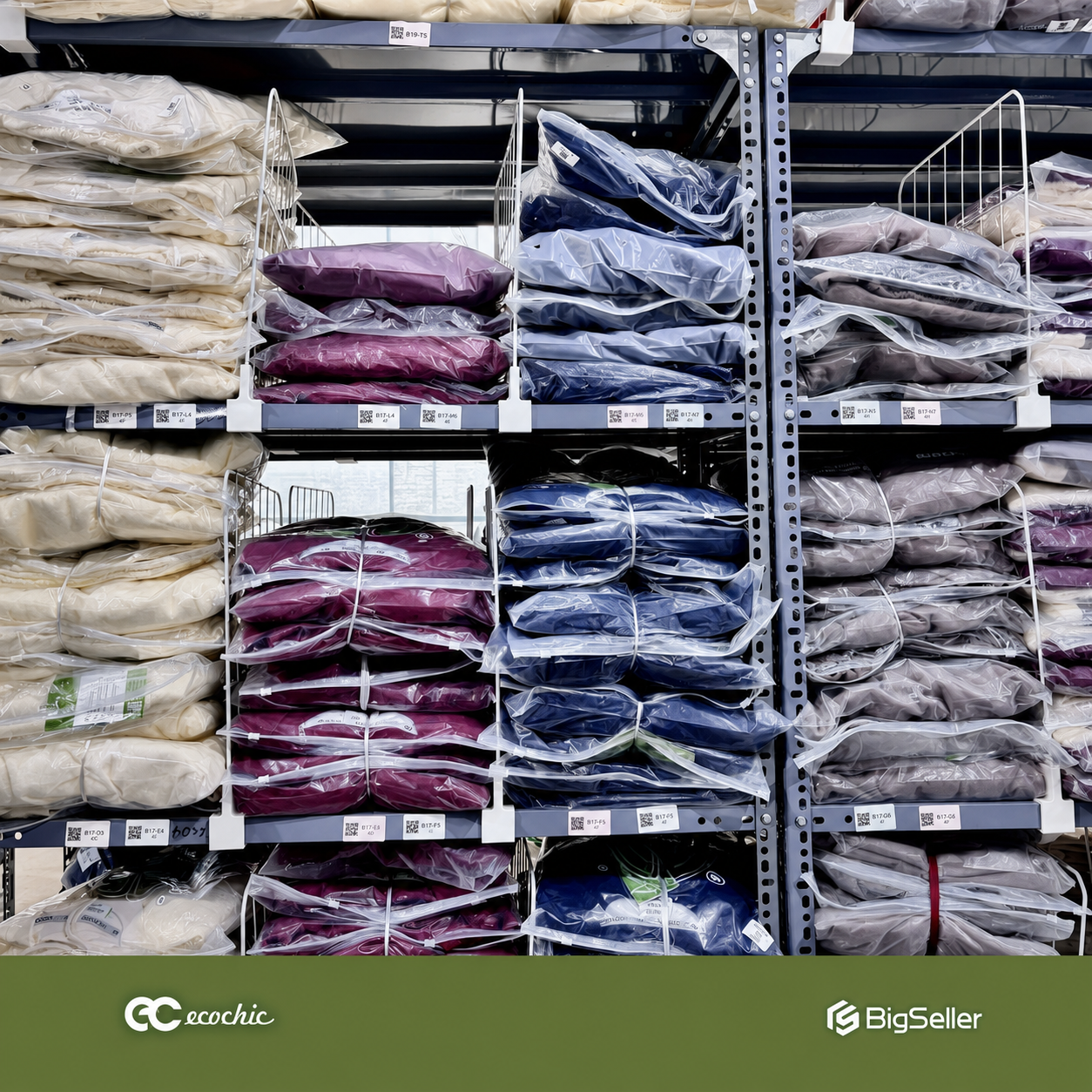
The reason lies in the nature of the products: many styles, many colors, many sizes, and many SKUs. For the same design, simply having sizes S, M, and L and colors such as gray, blue, and beige creates many different variants. As product volume increases, finding the right style, right color, and right size becomes a major challenge.
Before digitizing the warehouse, ECOCHIC's item location management depended heavily on the experience of warehouse staff. Where goods were stored, which products were running low, which styles had been sitting for a long time, and which areas were overloaded were often remembered through personal experience.
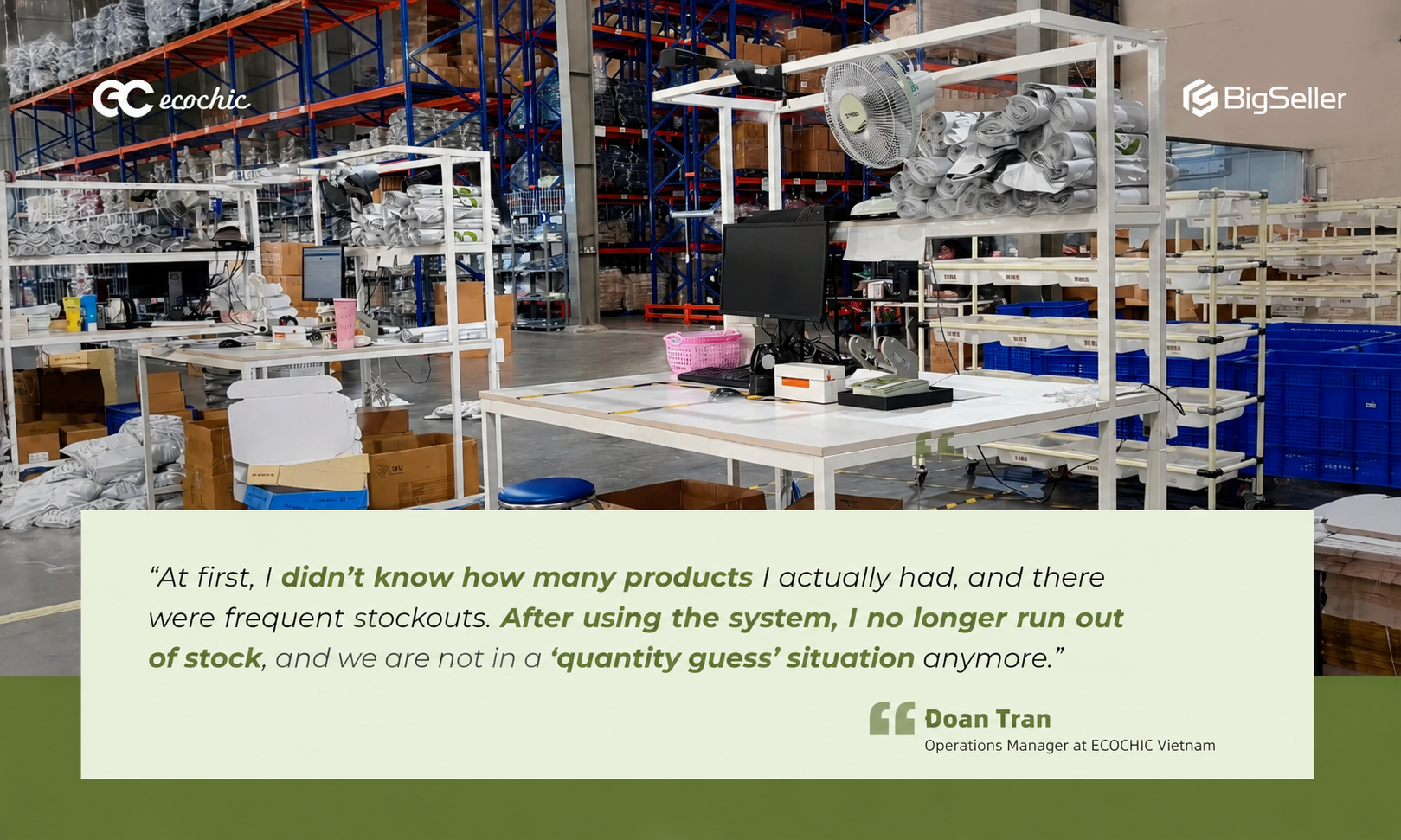
This approach can be effective when the team is stable and the warehouse is not yet too large. But as products and orders increase, risks rise as well. If the responsible warehouse staff leaves or new people join the warehouse, onboarding takes much longer. Mistakes such as picking the wrong color or size, or spending too much time searching for items, also become more likely.
BigSeller WMS helped ECOCHIC bring warehouse operations into a clearer management process. Product locations are recorded, and inbound receiving, shelving, picking, and inventory checks are supported by the system.
For ECOCHIC, WMS means the warehouse is no longer a place where only a few people "know everything." Instead, information is made transparent in the system, helping the operations team coordinate more easily and reducing dependence on individual memory.
Key changes include:
- When goods enter the warehouse, staff can scan codes to record storage locations.
- When items need to be picked, the system helps identify the product location, making it easier to find the right style, size, and color.
- With PDA devices, picking and inventory checking become faster and clearer.
- Actual inventory data and system inventory data can be reconciled more conveniently.
- New staff can work based on system processes, shortening training time.
For ECOCHIC, WMS not only helps the warehouse operate faster, but also reduces the risk of errors in details that may seem small but are very important to fashion customers: color, size, and style.
When a customer orders a beige dress in size M, what they expect is very simple: to receive exactly the product they selected. But to ensure this across thousands of orders, the brand needs a warehouse system that is accurate enough.
Results: When Operations Are Systematized, Growth Becomes More Sustainable
After optimizing its operating processes with BigSeller, ECOCHIC recorded clear improvements in its e-commerce operations.
According to feedback from ECOCHIC's team:
- Order processing time decreased by about 50%.
- Operational efficiency during Mega Sale periods increased by about 3x.
- Wrong shipments and order cancellations were controlled more effectively.
- Inventory management, order processing, and warehouse workflows became clearer.
- The operations team significantly reduced manual processing pressure during peak periods.
Beyond operational improvement, ECOCHIC's business performance also continued to grow positively:
- Sales on TikTok Shop reached an impressive scale, growing by more than 80% year over year.
- The Shopee channel maintained stable growth, with overall growth of more than 50%.
However, for ECOCHIC's team, the greatest value of systematizing operations is not only reflected in growth numbers. More importantly, the brand can escape the constant cycle of processing orders, firefighting inventory issues, and resolving unexpected errors.

"In the past, every day started with processing orders, checking stock, and urgently replenishing inventory. We almost had no time left for more important work. Now that the operating process has gradually stabilized, the team can return its focus to content, marketing, and products."
- Doan Tran, E-commerce Operations Manager at ECOCHIC
This is also the core value of digital operations: not only helping a business sell one more order, but also helping the brand maintain stability as it grows quickly.
From Well-Crafted Products to Scalable Operations
ECOCHIC's story is not an "overnight success" miracle.
It is the journey of a brand that persistently improves every product, builds trust through real customer experiences, accumulates awareness through content and community, and then gradually standardizes operations so it can handle a larger scale of growth.
When the #ecochic hashtag passed 200 million views, the brand gained more opportunities to reach consumers. But to turn views into orders, and orders into positive shopping experiences, ECOCHIC needed a solid operating system.
BigSeller has supported ECOCHIC in three important areas:
- Multi-platform inventory synchronization: helping reduce overselling, stockouts, and order cancellations.
- Automated order processing: helping the team process orders faster, especially during peak seasons.
- WMS warehouse management: making the warehouse more transparent, easier to control, and less dependent on manual operations.
Today, interest in ECOCHIC continues to grow. But for the operations team, the greatest sense of achievement comes not only from GMV or growth speed, but from the confidence to face an increasing volume of orders.
"No matter how many orders come in, we can still handle them."
- ECOCHIC team
For ECOCHIC, growth is no longer only a story of traffic or sales. It is also the story of a resilient operating system that allows the brand to keep going further.
Are You Also Selling Across Multiple Marketplaces Like ECOCHIC?
If you are selling on TikTok Shop, Shopee, Lazada, or multiple e-commerce platforms at the same time, problems such as inventory discrepancies, manual order processing, and a difficult-to-control warehouse with many SKUs may be quietly reducing your shop's operational efficiency.
BigSeller helps sellers centrally manage orders, inventory, and warehouse operations across multiple platforms, reducing manual work, limiting errors, and improving order processing efficiency.
Experience BigSeller to build a more efficient multi-platform operating system for your shop.